 Hexreceipt
The short version
- Keep a logbook for at least 12 continuous weeks that reflect how you normally use the car.
- Record the odometer at the start and end of the 12 weeks, and every work trip: date, start and end odometer (or the km), and the reason.
- Business km divided by total km is your business-use percentage. You claim that share of your car costs.
- The logbook is good for five years, unless the way you use the car changes.
Two ways to claim a car you use for work
If you use your own car for work (not just driving to and from your workplace), the ATO gives you two methods. You choose one per car, each year.
| Cents per km | Logbook | |
|---|---|---|
| What you claim | Work km times a set rate | Your business-use % of your actual car costs |
| Limit | 5,000 work km per car per year | No km limit |
| Records | Show how you worked out your work km, such as a trip diary | A 12-week logbook, odometer readings, and receipts for your car costs |
| Rate | 88c per km for 2024-25 and 2025-26; 91c for 2026-27 | Not used |
| Usually better for | Lighter work use, or a cheap car to run | Heavy work use, over 5,000 km, or high running costs |
The cents per km rate covers all your running costs: fuel, servicing, registration, insurance and depreciation. So under that method you can't claim those receipts on top. Under the logbook method, those receipts are exactly what your percentage applies to.
Keeping the 12-week logbook
Pick a normal stretch
The 12 weeks must be continuous and broadly representative of your work travel for the whole year. Avoid a period that is unusually busy or quiet, such as one that includes your annual leave. If you only started using the car for work late in the financial year, you can carry the logbook on into the next year to complete the 12 weeks.
Record these for the period
- The dates the logbook starts and ends.
- The odometer reading on the first day and the last day.
- The total km travelled over the 12 weeks (closing minus opening odometer).
Record these for each work trip
- The date.
- The odometer at the start and end, or the km travelled.
- The reason for the trip, such as "Client visit, Parramatta" or "Site inspection".
Write each trip down at the end of the journey, or as soon as you can after it. You don't need to log private driving: it is simply the difference between your total km and your work km.
Then, every year you use it
Note the odometer at the start and end of each financial year (1 July and 30 June) you claim with this logbook, and keep receipts for your car costs. Fuel and oil can be worked out from actual receipts, or reasonably estimated from your odometer records.
Working out your business-use percentage
Divide the work km you logged in the 12 weeks by the total km driven in the same period, then multiply by 100. Apply that percentage to your car costs for the year.
For comparison, 1,500 work km every 12 weeks is about 6,500 over the year. Cents per km stops at 5,000 km, so it would give 5,000 times 88c, or $4,400. With lighter driving or a cheaper car the answer can flip, so it pays to run both numbers.
How long a logbook lasts
One 12-week logbook can be used for five financial years: the year it starts in and the four after. If your circumstances change, for example you change jobs or move house, and the old logbook no longer reflects your work driving, keep a new one.
What doesn't count as a car expense
- Parking and tolls on work trips aren't part of the car claim. They're claimed separately as work travel, whichever car method you use. Parking at or near your regular workplace doesn't count.
- Driving between home and your regular workplace is generally private, even if you do it every day. There are exceptions, such as carrying bulky tools you need for work.
Keep your logbook in Hexreceipt
Hexreceipt is an iPhone and iPad app for Australian work deductions, and it keeps your car logbook alongside your receipts.
- Log a work trip in seconds from Siri, Control Center or the app icon. Your car, today's date and your last odometer reading are already filled in.
- Optional reminders at the end of each logbook week, for your closing odometer, and on 30 June.
- Your business-use percentage worked out for you, with your claim shown both ways, cents per km and logbook, side by side.
- Your trip log and car receipts go straight into the year-end bundle for your accountant.
Logging trips is free. A one-time Pro unlock works out the claim and generates the bundle. Your data stays in your own iCloud: no account and no tracking.
Download on theApp Store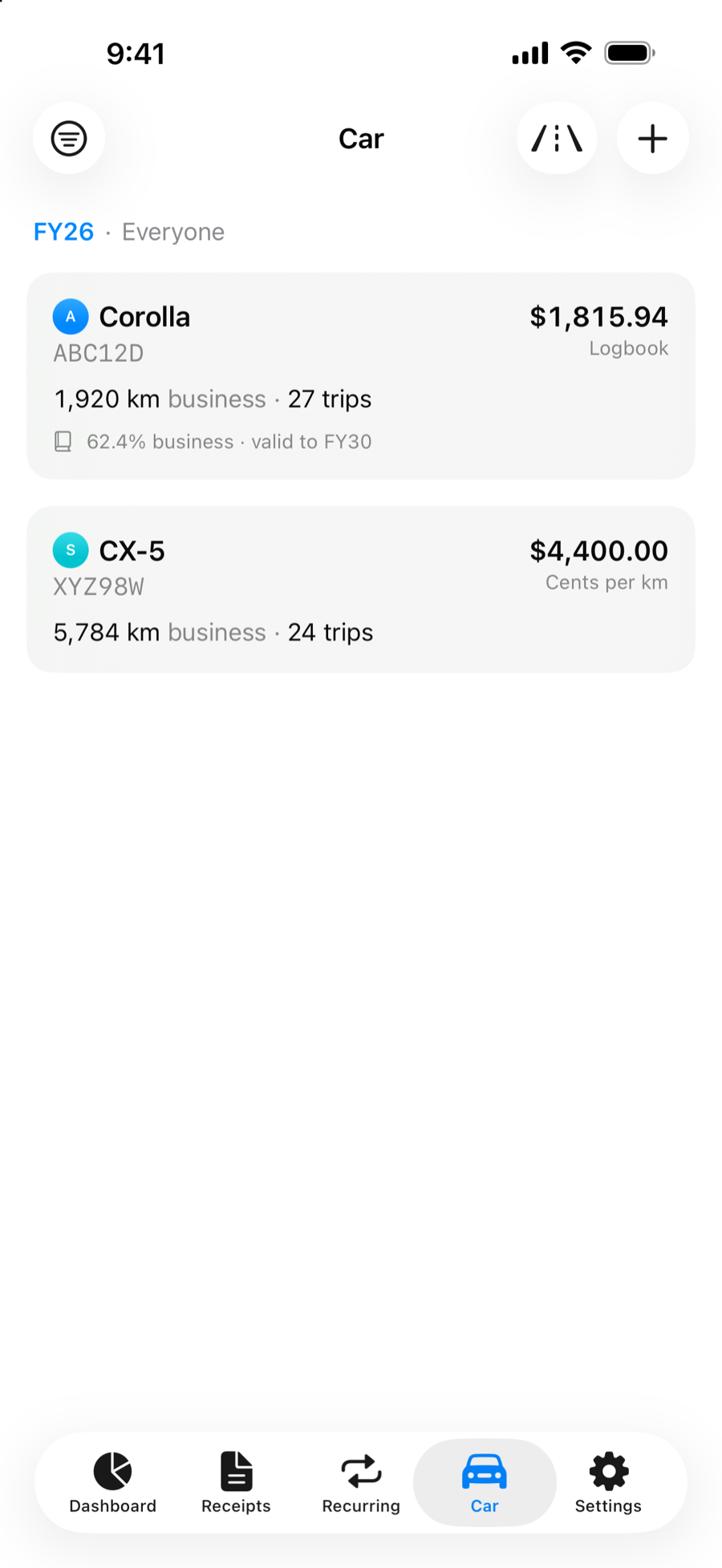
General information only, not tax advice, current as of November 2026. Rules and rates can change, so check the ATO's pages on the logbook method and the cents per km method, or ask your tax agent, before you lodge.